
Joliet City Directories by Year
Joliet’s surviving shelf begins before the long Polk era. The Joliet Public Library History and Genealogy collection reports Will County directories for 1859-60 and 1872-73, Joliet city directories from 1875 to the present, and telephone books beginning in 1908. The Joliet Area Historical Museum’s detailed holdings identify exact titles and years. Its list must be read as a run with gaps, not as proof that every year was published or survives.
| Collection | Years located | Where held | Access |
|---|---|---|---|
| Will County directories | 1859-60; 1872-73 | Joliet Public Library | Local History Room |
| Early Joliet directories | 1875; 1877 | JPL and JAHM | Library or museum archive |
| Digitized Polk’s Joliet | 1912 | Google Books | Free page images and OCR |
| Polk city directories | 1929-97 with gaps; 2002 | JPL and JAHM | Exact year by request or shelf |
| Telephone directories | 1908-present generally | JPL; selected JAHM years | In person |
The locally named early titles include the 1872 Will County Directory published by the Joliet Republican, the 1875 Directory of the City of Joliet, and Western Publishing’s 1877 Joliet City Directory. An 1899 R.G. Dun volume and a 1918 Prairie Farmer directory widen the context. The long Polk holdings include 1929, 1935, 1937, 1938, 1940, 1942, 1953, 1954-55, 1958-60, 1962-69, 1971-87, 1989, 1991-93, and 1995-97, followed by a 2002 Joliet Area Polk.
The library’s collection page shows the range of local history sources around those volumes.

The collection places directories beside newspapers, obituary indexes, maps, and databases, which makes it possible to test a directory lead in another source.
Polk’s Joliet Runs Have Gaps
The museum holdings show clusters of Polk years rather than a smooth annual run. If 1970 is absent, consult 1969 and 1971. When both adjacent books keep the same surname and address, continuity becomes more plausible, but it is still an inference. A missing person can reflect a move, death, omission, late canvass, unlisted household, or a book that simply did not survive.
The 2002 Joliet Area Illinois Polk is the latest specifically named JAHM volume located in the research. The library’s broader “1875-present” description may include later materials, but the exact shelf year should be confirmed with staff. Ask for a title and date, not “all records about” a person. This keeps the request within a collection the librarian can check.
Note: Treat a missing year as a shelf gap until adjacent volumes, catalog staff, and other records show what happened.
Read a 1912 Joliet Entry
The digitized 1912 Polk’s Joliet directory offers a real sample rather than a guessed schema. Alphabetic entries show surname and given name or initials. They may include a trade, named firm, spouse or widow notation, and a numbered street address. The abbreviation “h” marks home. “bds” means boards or lodges. Page images should control when optical character recognition, or OCR, misreads a name.
| Name | Surname, given name, or initials; spouse and widow status may appear. |
|---|---|
| Work | Occupation abbreviation and sometimes a firm or employer. |
| Residence | House number and street after “h,” or a boarding address after “bds.” |
| Street entry | Street name, number, and listed occupants in reverse order. |
| Placement | Printed page in the volume, with no modern PIN or case number. |
- Criss-cross directory
- A section arranged by street and house number rather than surname.
- Householder index
- An address-order list of people identified with homes or households.
- Abbreviation key
- The publisher’s list that explains shortened terms used in entries.
- OCR
- Machine-read text from a scan, useful for finding words but less reliable than the image.
The scanned book itself can be reviewed online.
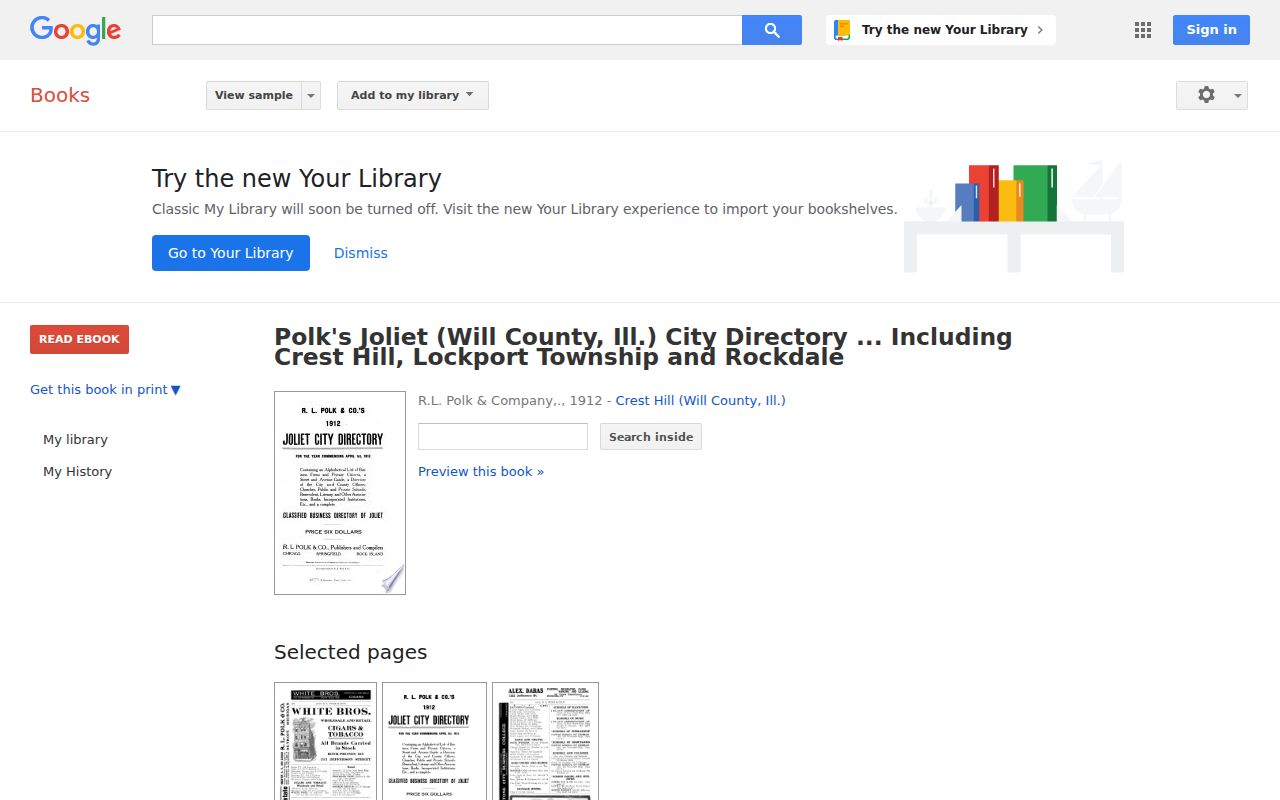
The digitized volume supports text searching, but the printed page preserves punctuation and abbreviations that OCR may lose.
Match Joliet Names to Streets
A city directory works in two directions. Begin in the alphabetic section when the surname is known. Copy the whole entry, including initials, spouse or widow note, trade, firm, address, and every abbreviation. Then move to the street section and locate the same house number. Nearby numbers may reveal relatives, boarders, coworkers, or simply neighbors who can help distinguish people with the same name.
The inspected 1912 entry page shows the printed evidence used for this method.
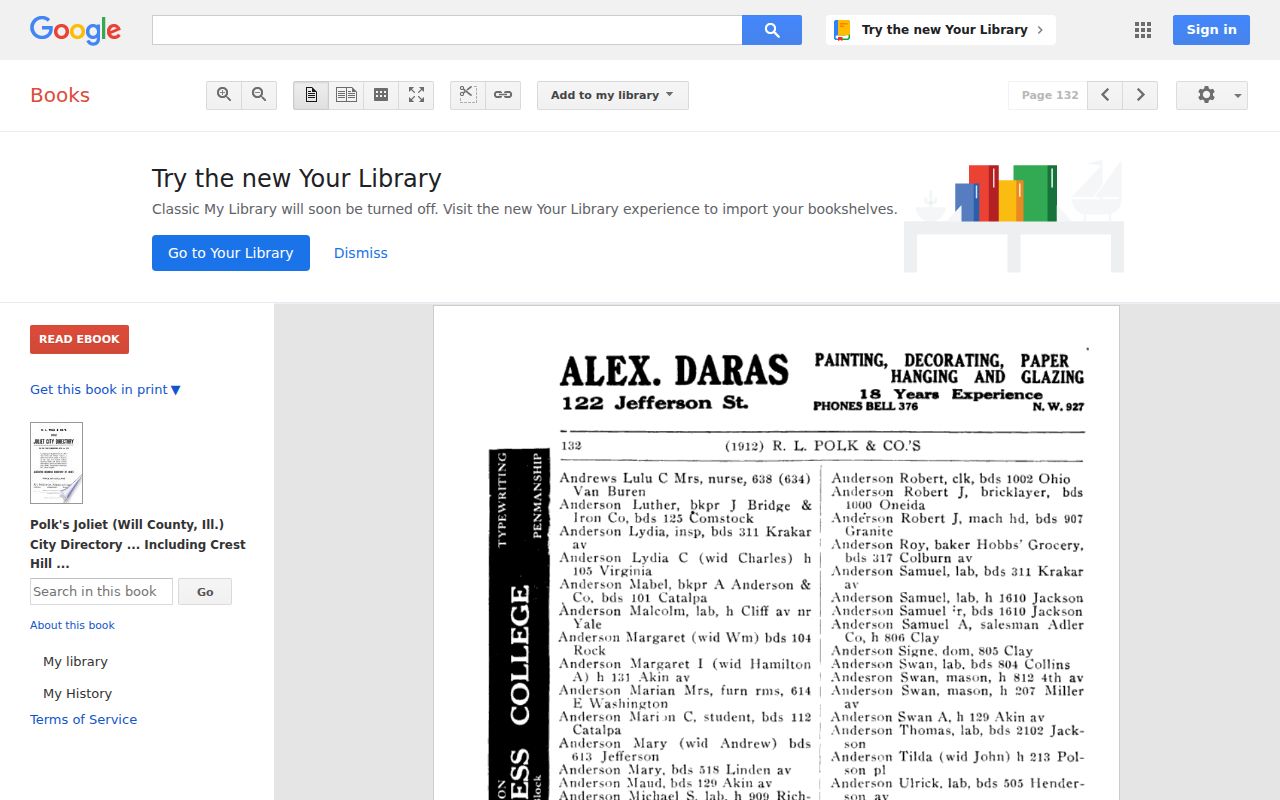
The page pairs names with work and residence details, making a later street-section check much stronger than a name hit alone.
Reverse searching is just as useful when only an old address is known. Start in the street section, note every listed occupant at the number, then return to alphabetic entries for full details. For a modern property chain, shift to the Joliet street address directory instead of forcing an old volume to answer a current question.
Joliet’s Local History Counter
The Ottawa Street Branch Local History Room is the main in-city research counter. Its posted hours are Monday through Thursday, 9 a.m. to 9 p.m.; Friday and Saturday, 9 a.m. to 5 p.m.; and Sunday, 1 to 5 p.m., with summer Sunday limits. A librarian appointment is required at 815-846-3112. Adult Services is available at 815-740-2666.
Holdings include newspapers on microfilm from 1846 to the present, atlases, plat books, high-school and university yearbooks, archives, and printed obituary indexes for 1915-18 and 1976-2012. Microfilm copies are free. Staff will search newspapers only when given a month and year. A good city directory entry can supply the address, trade, or rough event year needed to make that request workable.
- Bring the exact directory year and surname spelling.
- Record a page number and every abbreviation.
- Ask for neighboring years when the target year is absent.
- Give newspaper staff a month and year.
- Check yearbooks when tracing a former classmate.
Joliet Museum Fills Shelf Gaps
The Joliet Area Historical Museum archive is at 204 N. Ottawa Street, with archive contact at 815-723-5201 ext. 7214. Its newspaper material covers 1853-1924 and 1936-1987 with significant gaps. Herald News photographs span 1960-2000; Whiteside material covers 1981-88; Hodgdon papers span 1885-1949. These collections can add an event, business, building, or image when a directory entry is terse.
The museum’s holdings PDF is the key source for exact publishers and year runs, while the library remains the broad first stop. Plainfield Public Library is an adjacent fallback for Plainfield-Joliet directories, Will County histories, yearbooks, cemetery material, and Sanborn maps. IRAD at Northern Illinois University routes older Will County government and indexed material. No complete open parish-register inventory was located, so church or cemetery research should begin with the relevant institution or archive rather than an assumed public database.
Put Joliet Addresses on Maps
Directories name people, while maps explain the block. Joliet research materials point to an 1862 city map, an 1873 ward map and atlas, and Sanborn fire-insurance sheets for 1886, 1891, 1898, and 1924. JPL also holds Sanborn material for 1924-1956. A Sanborn sheet can show a footprint, use, building material, and lot relation. It does not name every occupant.
A strong address match uses the directory house number, the Sanborn lot and footprint, and the recorder’s legal description. This is vital where old street numbers differ from modern situs addresses. No verified citywide Joliet renumbering schedule was found. Lot, block, nearby addresses, and the legal description are safer bridges than guessing a year of change.
Before 1912, Joliet tax and building records stored in Chicago were destroyed by fire. That loss explains why a directory and map may show a house even when an early building card is absent. Reconstruct the date with maps, newspapers, directories, deeds, census schedules, and historic surveys. Do not turn a missing card into a false exact date.
Trace Joliet Families Across Years
Choose a firm starting point: a full name, address, and approximate year. Follow the person through available directory years, but preserve each spelling and initial. A spouse note, widow notation, trade, employer, or boarding marker can separate two residents with the same name. When the person vanishes, test nearby years before deciding whether the household moved or a death occurred.
- Find the earliest reliable alphabetic entry and transcribe it exactly.
- Read the street section for the address and nearby house numbers.
- Move to the next available directory, recording every address or work change.
- Pair 1900, 1910, 1920, 1930, 1940, and released 1950 census schedules with close directory years.
- Use newspapers, obituary indexes, deeds, maps, and cemetery sources to close the trail.
The 1890 federal census was destroyed nationally, so that gap is not unique to Joliet. Directory publication dates also differ from census enumeration dates. A person can move between them. The volume may reflect the canvass date, not the date printed on its cover. For a former classmate, combine school yearbooks, directories, newspapers, and alumni archives rather than relying on one modern name match.
What Joliet Directories Cannot Prove
A city directory is a commercial publication snapshot. It can show that a publisher associated a listed person with an address and occupation around one period. It cannot prove title, citizenship, legal domicile, exact move dates, or current occupancy. Boarders, children, people who declined to list, and residents missed by canvassers may be absent. Telephone books are narrower because they depend on subscribers.
OCR errors can hide a correct printed entry. Search spelling variants and inspect the page image. When a year is missing, use adjacent volumes and say that continuity is inferred. A directory address should be tested against maps or deeds before it is tied to a modern parcel. These limits do not weaken the collection; they show how to use it honestly.
Key point. One Joliet city directory entry is a dated lead. Two years plus a map, census, or deed form a stronger history.